









Some see personalization as two-dimensional: a piece of content is either personalized, or it isn’t. In reality, personalization can happen at different degrees depending on the circumstance. For example, a fast-moving marketing campaign may not be as deeply personalized as a customer account moment is.
Video in particular is where personalization can make a real impact: it’s already the preferred format for most customers, with 63% of people saying they’d rather watch a short video than read text to learn about a product or service. Combine that attention with the relevance of personalized content, and you have a powerful way to turn a routine customer update into a moment that builds trust.
This article breaks down what video personalization means, the different approaches enterprises can use, and the technology that makes it all possible.
What is video personalization?
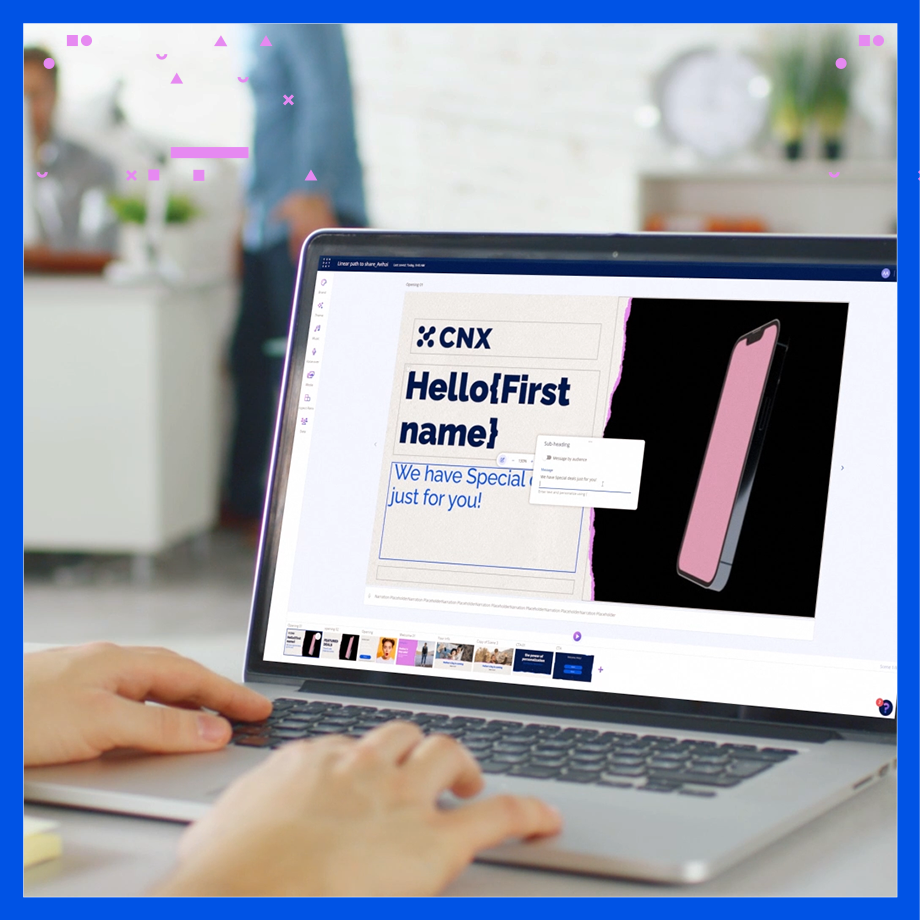
Video personalization is the practice of dynamically tailoring video content to a specific viewer or audience segment, using data about who they are or what they’ve done. Instead of a one-off video sent to many, a personalized video adapts what’s shown based on real information: a customer’s name and account details, lifecycle stage, behavior, or something else.
With this approach, companies can send a single video to thousands of viewers, and each person will see a unique version tailored to them—automatically and dynamically.
What can you personalize in a video?
Once you know a video will be personalized, the real question is what can change from viewer to viewer. In practice, it can be any combination of:
- On-screen text: names, account numbers, balances, rates, or renewal dates, updated directly on screen.
- Visuals: images, product shots, or backgrounds swapped based on a viewer’s plan, product, or preferences.
- Narration: the voiceover script (and even the voice itself) adjusted to match a viewer’s language, tone, or specific details.
- Scenes: entire scenes included, skipped, or reordered depending on what’s relevant: a compliance disclosure for one segment, an upsell offer for another.
- CTAs: each viewer pointed to their own next best action: activate a card, schedule a call, complete enrollment.
- Brand elements: logos, colors, or messaging adjusted for co-branded or partner-facing use, like broker- or agent-branded videos.
All three types draw on the same toolkit; what changes is how precisely it’s applied. Contextual and Segmented personalize by group, tailoring elements like text, visuals, or scenes to an audience. 1:1 Dynamic applies that same flexibility to a single viewer, live, every time the video plays.
Three degrees of video personalization
Personalization strategies are not one-size-fits-all. There are distinct types of video personalization: contextual, segmented, and 1:1 dynamic, each suited to a different job.
Contextual: Fastest to value
Contextual personalization tailors a video by audience segment, channel, or campaign context. For example, the industry a viewer works in, the channel they came from, or the campaign they’re part of. Activation is simple, and a contextual video can go live in days. Think: a broad awareness campaign, a first touch, a general product announcement.
Segmented: Higher relevance
Segmented personalization uses CRM, product, or behavioral data to dynamically build targeted video variants for defined audience segments. For example, a version for new customers versus renewing ones, for a specific product line, for a particular lifecycle stage. It takes more data than contextual personalization, but it earns real relevance beyond the channel someone happened to click from.
1:1 Dynamic: Maximum impact
1:1 Dynamic takes personalization to the max: every viewer sees a video unique to them, rendered in real time from their data. Think: name, account details, activity, balances, or current status, using whatever is true about their account right then. This is where video personalization can have the most impact, and also where it requires the most underlying infrastructure to do well.
No single type is inherently “better.” Each one describes a fit rather than a hierarchy. The type of personalization that fits a broad campaign announcement is different from the type that fits a customer’s claim-status update. Enterprise teams need to use all three, each applied to the appropriate moments.
Why real-time rendering matters
A video that’s rendered once and distributed is frozen at the production level. If a rate changes, an offer expires, or an account status updates after the video sends, it no longer reflects reality, and few teams have the bandwidth to go back and re-render every copy every time there’s an update.
Video created in SundaySky, whether contextual, segmented, or 1:1 dynamic, is rendered in real time—assembled at the moment someone presses play, pulling the latest available data. The same video link can reflect a different balance, status, or offer today than it did last week. That matters at every level, but especially for 1:1 Dynamic, where the data in these videos (account balance, a specific claim status, etc.) is continuously changing.
For regulated industries, this isn’t a nice-to-have. A stale APR, an outdated benefit detail, or an incorrect claim status results in a poor viewer experience. Real-time rendering keeps every video current by construction, without someone having to remember to update it.
Matching the type to the moment
Because contextual, segmented, and 1:1 dynamic personalization solve different problems, the question enterprise teams should ask isn’t “how personalized can we get?” it’s “what does this moment actually need?”
High-velocity, broad reach → contextual
A product launch announcement, a broad brand campaign, an initial outreach to a large list. These campaigns need to move fast and reach a lot of people. Contextual personalization, tailored by channel or campaign context, gets a relevant video live in days without waiting on data integration.
Defined-segment relevance → segmented
A renewal reminder for a specific product line, a feature announcement for a particular customer tier, a “getting started” video for customers in their first 90 days versus a “what’s new” video for established ones all benefit from segmentation. The audience is defined and knowable, with messages that apply to these specific groups.
Individual, high-stakes moments → 1:1 dynamic
Onboarding with someone’s personal account details, a claim status update, a renewal built around a customer’s specific balance or usage. These are the moments when a viewer decides, consciously or not, whether a company truly knows them. Getting these wrong with a generic or segmented video can read as indifference in a moment where winning trust is critical.
The cost of mismatched personalization runs in both directions. Using contextual personalization on a high-stakes renewal reads as impersonal. Using 1:1 dynamic personalized infrastructure for a broad, low-stakes campaign is more machinery than the moment calls for.
Matching the type to the moment, instead of defaulting to the most advanced option every time, is what makes a video personalization program efficient and effective.
Learn more about video personalization with SundaySky, and how the platform covers all three types.
What data powers video personalization?
A common assumption is that meaningful personalization requires a major data science build. It doesn’t.
- Contextual personalization can run on simple campaign metadata or channel source.
- Segmented personalization typically draws on first-party CRM, product-usage, or behavioral data, the kind of information already sitting in a Salesforce, HubSpot, or Marketo instance.
- 1:1 Dynamic personalization goes further, drawing on a viewer’s own account and activity data to render each video individually.
For security- and compliance-conscious teams (which describes most enterprise buyers in financial services, insurance, and healthcare), this matters: personalization connects to the systems you already run [see how data integration works] with the encryption and compliance controls, including SOC 2, HIPAA, and GDPR, that those teams already require.
Video personalization use cases across the customer lifecycle
Onboarding & activation
The first 90 days are the highest-risk window in most customer relationships. A personalized onboarding video that reflects a customer’s plan, account, or setup, rather than a generic walkthrough, builds the early confidence that can predict whether someone becomes a long-term customer.
Ongoing communications & product adoption
Statements, notices, and feature announcements are where most personalization programs live day-to-day. Segmented or 1:1 dynamic video turns a notice that would otherwise go unread into something a customer actively watches and understands, helping reduce the support calls that come with low comprehension.
Renewal, retention & relationship growth
Renewal reminders, loyalty recaps, and relationship-deepening offers are naturally high-stakes: the customer is implicitly deciding whether to stay. This is where 1:1 dynamic personalization, created from a customer’s account and usage data, tends to earn its keep.
The specific data and moments shift by industry. For example, a policy renewal in insurance, a rollover in retirement services, a QBR in SaaS—but the underlying pattern holds across all of them.
Video personalization examples
Each type looks different in practice. Here’s how contextual, segmented, and 1:1 dynamic personalization play out for real enterprise teams.
Contextual: Think a product launch, a broad awareness campaign, or a first-touch outreach to a new list. Video tailored by channel or campaign context is the fastest way to get something relevant and on-brand in front of a broad audience, because it doesn’t require any data integration to activate.
Segmented: A major energy retailer personalized first-bill explainer videos for new-customer segments using account and plan data—cutting call-center tickets by 42%, reducing service calls by 19%, and lifting email engagement by 30%.
1:1 Dynamic: A major online brokerage personalized onboarding video with each customer’s own funding activity and account data, rendered individually. The result: a 104% lift in average initial funding amount, a 130% lift in net new assets, and a 23% lift in average annualized revenue compared to generic onboarding communications.
Want to see similar examples in action? See them in our other post: 13 personalized video examples you can actually scale
The business case for video personalization
The case for video personalization comes down to the same two levers as any technology investment: cutting costs and growing revenue.
On the cost side, enterprise teams using personalized video have seen a 35% reduction in call-center volume, a 35% increase in self-service adoption, and up to 90% savings in production time and cost compared to traditional video production.
On the revenue side, results include a 40% lift in incremental revenue, a 23% reduction in early-life churn, and an average 207% ROI on the programs measured.
For most enterprise teams, the pitch isn’t video vs. no video; it’s replacing generic, one-size-fits-all communications with something that reflects who’s actually watching. That’s what turns a compliance notice, a churn-risk renewal, or a routine onboarding message into something a customer acts on instead of ignoring.
How enterprise teams get started
SundaySky is the platform for building and personalizing video across all three types, from a contextual campaign video to a fully 1:1 dynamic video, real-time-rendered account update. Editors work in a single studio, personalizing on-screen text, narration, visuals, and even entire scenes without needing video production or design expertise.
SundaySky Amplify puts personalization into the hands of client-facing teams. Think: sales reps, account managers, advisors. Etc. These roles simply fill in the allocated fields in a template to send a personalized video in minutes, without going back to production. It’s made for the moments that live closer to an individual relationship: a prospecting outreach, a meeting recap, a renewal conversation.
FAQ
Is video personalization the same as AI avatars?
No. AI avatars are a production technique, i.e., a way to generate on-screen presenters without filming a person, and can appear in a personalized or a non-personalized video. Video personalization refers to tailoring the content itself (visuals, narration, offers, or storyline) to a specific viewer or segment, regardless of whether an avatar, a real presenter, or no on-screen presenter is used.
Does video personalization require sensitive customer data?
No. Contextual personalization can run on campaign or channel metadata alone. Segmented and even 1:1 Dynamic personalization can be generated from first-party or behavioral data: a name, an account status, a usage pattern, without requiring sensitive or secure customer data to be effective.
How is video personalization different from dynamic ad insertion?
Dynamic ad insertion swaps a discrete ad unit into a video stream, typically based on broad targeting data like location or device. Video personalization changes the substance of the video content itself: narration, visuals, offers, even which scenes appear, based on who a specific viewer or segment is, and can go as far as rendering a unique video per person.
Can video personalization work without a large data team?
Yes, especially at the contextual and segmented levels, which typically draw on data already sitting in a CRM or marketing automation platform. Even 1:1 Dynamic personalization is designed to pull from existing systems like Salesforce, HubSpot, Snowflake, and similar sources—rather than requiring a dedicated data science build.
Conclusion
Most enterprise teams don’t need to pick one type of video personalization and standardize on it forever; they need to know which type fits the moment in front of them right now.
If you’re mapping out where contextual, segmented, or 1:1 dynamic personalization would have the most impact on your next onboarding sequence, renewal cycle, or high-stakes customer moment, we’re glad to walk through it: book a demo to see all three types on one platform, or watch the 5-minute platform tour to see 1:1 Dynamic, real-time-rendered video in action.