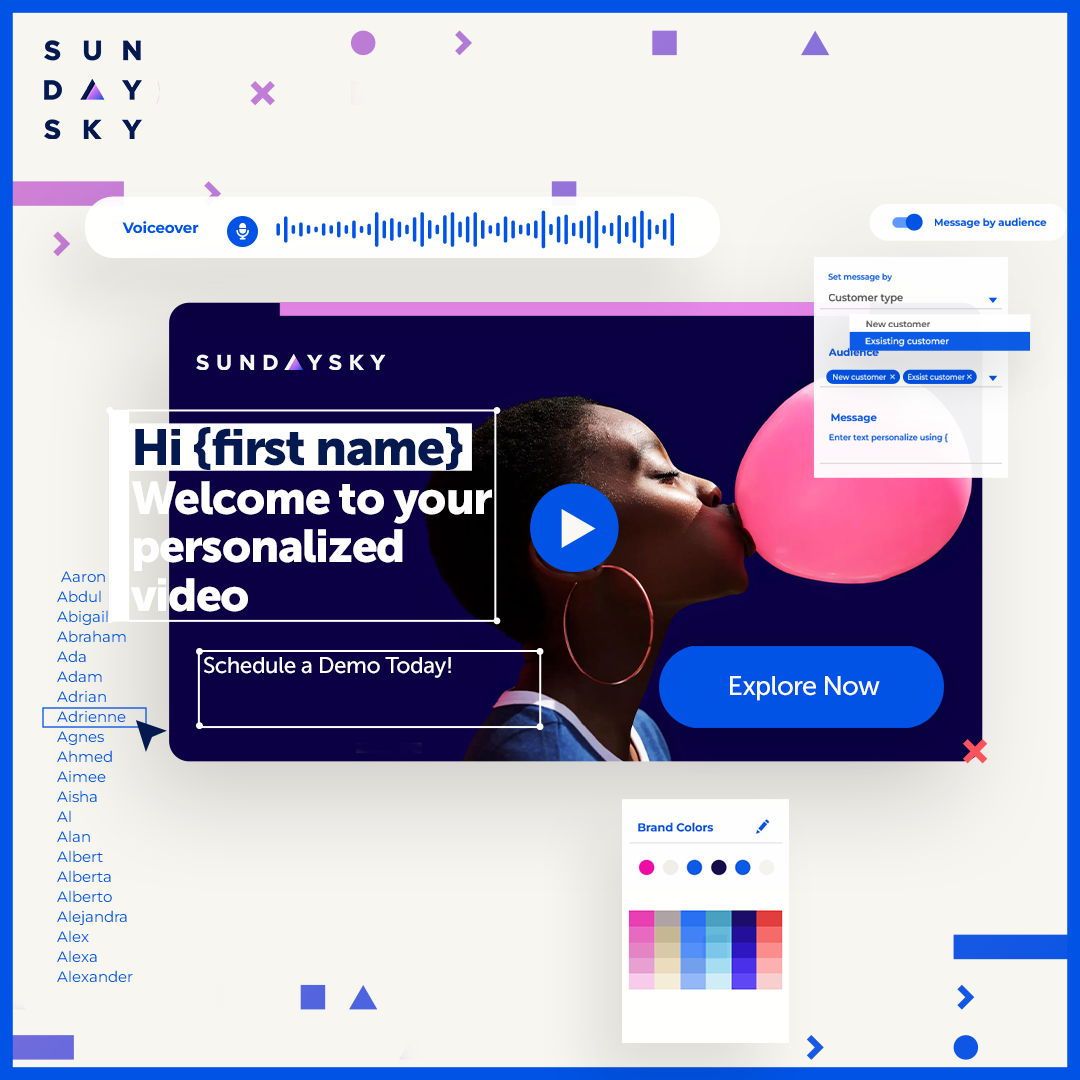


We’re living in the age of the scroll, and video is winning.
With the average viewer spending 17 hours per week consuming video content (that’s roughly 2.5 hours every single day), video has become the default way that people consume information.
Whether they’re watching for entertainment, learning about a product, onboarding with a new service, or catching up on company updates, it’s the universal language for reaching both customers and employees. The key takeaway for businesses? Video needs to scale across your organization through scalable video production. That means making it a core communication strategy across every team, from sales to customer experience to training.
The scaling paradox: When growth threatens control
But here’s the challenge with scaling: the more teams you empower to create video, the more risk you introduce to your brand. More creators can mean inconsistent messaging, off-brand visuals, and compliance headaches.
Think sales reps going rogue with unapproved prospecting videos. Regional teams creating localized content in five different visual styles. L&D departments building training videos that all look and sound completely different.
The democratization dilemma becomes real. You want to empower your teams to create content independently, but you also need to protect your brand.
But here’s what happens when fear of losing control wins out:
- Marketing becomes the bottleneck, slowing production to a crawl
- Teams miss market opportunities while waiting weeks for approvals
- Sales can’t respond to prospects quickly enough
- Customer onboarding gets delayed
- Training content remains endlessly backlogged
Your team needs videos to communicate. But how do you scale video creation across your entire organization without turning your brand into a free-for-all?
The technology approach to scaling video without sacrificing brand control
Scaling video creation doesn’t fail because teams don’t understand brand rules. It fails because those rules are hard to enforce at scale.
The fastest-growing enterprises don’t govern video through checklists, approvals, or documentation. They do it through technology that makes brand compliance automatic, so teams can move quickly without creating risk.
Here’s what that looks like in practice:
Centralize brand control inside the video platform
True video brand governance starts by embedding your brand directly into the platform, not managing it externally.
With the right enterprise video platform, marketing teams define brand standards once, then apply them everywhere:
- Logos, fonts, colors, layouts, tone, and legal language are built directly into the platform
- Critical elements are locked by default, eliminating off-brand edits
- Approved assets live in a single system of record, always up to date
When brand rules live inside the platform, compliance isn’t something creators need to think about; it just happens.
Scale creation with templates that enforce consistency by design
Templates are the backbone of scalable, on-brand video creation, but only when they’re designed for real-world use.
Instead of asking teams to follow guidelines, leading organizations:
- Build reusable video templates aligned to specific use cases (sales outreach, onboarding, training, internal updates)
- Define exactly what can and can’t be customized within each template
- Allow teams to personalize messaging without touching protected brand elements
This approach replaces manual reviews with built-in guardrails, making it possible for hundreds (or thousands) of creators to produce videos that all feel like they came from the same brand. Learn more about building reusable video templates with SundaySky Amplify
Enable self-service video creation without brand risk
Scale only happens when video creation is easy enough for non-marketers to use.
The right platform makes self-service safe by:
- Applying role-based permissions automatically
- Giving teams “safe zones” for personalization while locking brand-critical components
- Eliminating the need for design skills, video editing expertise, or brand knowledge
Sales reps can personalize prospecting videos. CX teams can tailor onboarding. L&D teams can update training content. And marketing doesn’t become the bottleneck—or the brand police.
Keep every video up to date automatically
One of the biggest hidden risks of scaling video is brand drift over time.
When logos change, disclaimers update, or messaging evolves, traditional video libraries become outdated almost instantly. Enterprise teams solve this with real-time rendering and dynamic updates:
- Brand changes are applied once and reflected across every video automatically
- Existing videos update without re-editing or re-publishing
- Teams stay agile without sacrificing consistency
Brand governance becomes continuous and not reactive.
Governance that accelerates growth, not approvals
When brand control is built into the platform, governance stops being a blocker.
Instead of slowing teams down, it enables:
- Faster time-to-market for campaigns, sales outreach, and customer communications
- Lower compliance risk without manual oversight
- More video creation across more teams without chaos
That’s the real shift: governance as an enabler of scale, not a constraint.
Tactical best practices for each team
The framework gives you the foundation, but execution looks different depending on who’s creating the branded video content. Here’s how to tailor your approach for each team’s unique needs.
For marketing teams
Marketing often owns the brand governance framework, but they’re also power users who need creative flexibility. Here’s how to give them both:
Create scalable video production campaign templates: Build frameworks that flex across channels and product lines, with locked brand elements and customizable messaging zones.
Manage seasonal updates efficiently: When brand assets change, use platforms with real-time rendering that push updates across your entire video library instantly—no manual re-editing required.
Balance creative freedom with standards: Give marketing teams room to experiment within defined guardrails. Let them test different hooks, CTAs, and storytelling approaches, but keep the core brand elements locked.
For sales teams
Sales need speed and personalization, but they can’t compromise brand integrity or compliance. Enable velocity without risk by focusing on:
Enable personalized prospecting: Provide templates with locked branding where reps can customize prospect names, pain points, and case studies in minutes, with no design skills needed.
Build quick workflows: If customization takes more than 5 minutes, reps won’t use it. Design sales enablement workflows where they can swap fields, record a quick intro, and then send it.
Address compliance early: In regulated industries like financial services or healthcare, build compliance checkpoints into your templates so reps can’t accidentally make unapproved claims. Pre-approved language libraries and required disclaimers should be baked into the template, not optional additions.
For customer experience teams
CX teams need scalable video production to deliver personalized communication without sacrificing quality or consistency.
Scale onboarding across segments: Build templates that can be personalized based on customer tier, product package, or use case. Every customer gets premium treatment, tailored to their needs. Companies like Constant Contact use personalized video to simplify onboarding, accelerating time-to-value as well as boosting retention.
Maintain consistency in support content: Create a support video library with standardized formats for common issues like password resets, feature tutorials, and troubleshooting guides. Every video should look and feel like it came from the same brand, even if different team members created them.
Personalize at scale while staying on-brand: Use video personalization to address customers by name, reference their specific account details, or highlight features relevant to their usage, all within brand-approved templates. Bank of America, for example, uses personalized video to convey transparency in their rewards program, deepening customer relationships.
For learning & development teams
L&D teams need to produce high volumes of branded video content for training quickly, and it all needs to feel cohesive. Think modular, not one-off:
Create cohesive training libraries: Build a modular system where courses, modules, and lessons share the same visual language. New hire onboarding and compliance training should feel like part of the same learning ecosystem.
Reinforce company culture through internal comms: Internal videos are brand touchpoints too. CEO updates, benefits explainers, and team celebrations should all reinforce your culture through consistent identity.
Update training without starting over: When features or policies change, swap outdated information without recreating entire videos. Update the screenshot, change the date, and click refresh.
Turn brand governance into your growth engine
The real goal isn’t just producing more videos. It’s producing them faster while maintaining the integrity that makes your brand recognizable and trusted. Done right, brand governance transforms from a gatekeeping function into a competitive advantage.
Consistent, on-brand video content builds trust faster than inconsistent content ever could. When every touchpoint, from a sales prospecting video to a customer onboarding sequence, reinforces the same professional identity, you’re not just protecting your brand. You’re strengthening recognition, credibility, and customer confidence at scale. Research shows that consistent brand presentation can increase revenue by 10-20%.
This translates into tangible business results:
- Faster time-to-market: Teams produce videos in hours, not weeks, without waiting for approvals
- Reduced compliance risk: Automated guardrails prevent brand drift and legal issues before they happen
- Empowered teams: More people creating videos independently means more customer touchpoints and faster responses
- Consistent brand experience: Every video reinforces trust across all customer interactions
- Real ROI: Companies using enterprise video platforms report 10x ROI, 86% reduction in production time, and 48-point NPS improvements.
You can either slow down to protect your brand, or you can build scalable video production systems that let you scale with confidence. With the right infrastructure, brand governance becomes what enables growth instead of what limits it. See how SundaySky makes scaling video possible without sacrificing brand control.