

Business teams don’t struggle with video because they lack ideas. With the right platform, video is already an effective and accessible way to communicate across the enterprise. The challenge is finding faster ways to turn existing content into video when time and attention are limited.
Across marketing, product, customer experience, enablement, and internal communications, teams know video is one of the most effective ways to communicate. But even with strong video workflows in place, teams often need to move faster and do more with the content they already have, especially when video isn’t their primary job.
At the same time, most organizations are sitting on a wealth of existing content: whitepapers, blog posts, release notes, product documentation, training materials, press releases, and internal updates. The challenge isn’t the quality of that content, but how quickly it can be transformed into video without slowing teams down.
That’s where AI document to video, or Doc-to-Video fits in.
Doc-to-Video won’t replace all video workflows. It’s built for a specific, common scenario: when teams already have content in the form of a document and want a faster, lower-effort way to turn it into video.
Why speed and familiarity matter for everyday video creation
As video becomes a more common part of everyday communication, the question isn’t whether teams can create video, but how quickly they can do it without disrupting their workflow.
SundaySky already makes it easy for teams to create high-quality, on-brand video. But in many real-world scenarios, especially for subject matter experts or infrequent creators, the fastest path to video is starting with content they already know.
When a product manager needs to explain a feature update, a communications leader needs to share a policy change, or a marketer wants to extend the reach of a whitepaper, the message is often already written. What those teams need is a way to turn that content into video without rethinking structure, rewriting messaging, or learning a new process.
That’s where Doc-to-Video adds value: by making it even easier to get started when documents are the natural source. This new feature was designed specifically for those moments.
A more practical approach: start where the content already lives
Most enterprise organizations already invest heavily in creating accurate, approved content. That material reflects real strategy, insight, and institutional knowledge.
The opportunity isn’t to replace that work, but activate it more efficiently.
AI has made it possible to analyze long-form documents, identify structure and intent, and turn that content into usable starting points for video. These become solid first drafts that reduce the amount of upfront effort required to create videos and speed up the path to a polished outcome.
Especially in document-driven moments, Doc-to-Video removes a meaningful source of friction.
From document to draft: how Doc-to-Video works
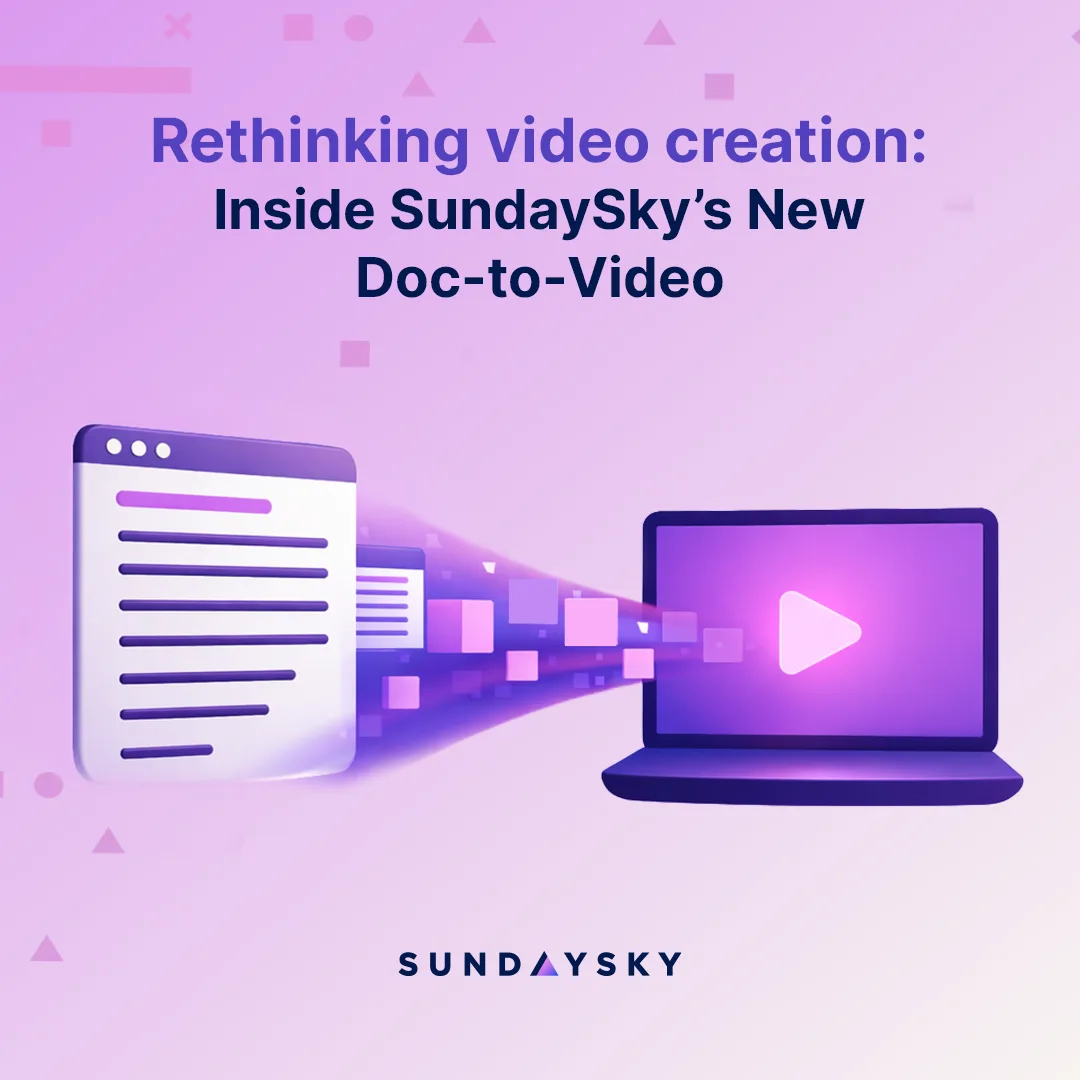
Doc-to-Video brings a document-first video approach directly into the SundaySky platform.
Teams can upload an existing Word document, PDF, or .txt file, and Doc-to-Video uses AI to analyze the text and generate a structured video draft. That draft includes suggested scenes, narration, and a clear narrative flow designed to reflect the intent of the original content.
The goal of Doc-to-Video is to generate a complete, editable first video draft. From there, teams have the flexibility to refine messaging, apply brand standards, adjust structure, and continue editing using the same familiar SundaySky workflows they already rely on.
By reducing the manual rewriting and structuring required to get started on video creation, Doc-to-Video dramatically shortens the time to first video draft without sacrificing control or quality.
What this update unlocks for business teams
Starting from a structured video draft changes the speed at which teams can create video, but the impact goes beyond that:
1. A faster path from content to video
Existing files become usable video drafts in minutes, helping teams move from idea to execution far more quickly.
2. Higher productivity with less effort
By eliminating manual rewriting and restructuring, creators can focus their time on refinement and storytelling instead of setup.
3. Greater ROI from existing content
Documents gain new life and reach when they’re repurposed into video, with minimal incremental work.
4. A lower barrier to video creation across teams
Doc-to-Video makes video more accessible to non-marketers and infrequent creators by removing the complexity of starting from scratch.
Together, these benefits help teams create more video with the content they already have, without extra hours of work.
Where Doc-to-Video is most valuable
Doc-to-Video is most effective in moments where content already exists, and speed, consistency, and efficiency matter more than building a new narrative from the ground up.
Common use cases include:
- Thought leadership: Turning whitepapers, blog posts, and research summaries into engaging video
- Product education and updates: Bringing feature launches, release notes, and documentation to life
- Press and company announcements: Transforming press releases, company updates, and leadership messages into video
- Customer education: Creating how-to guides, FAQs, and knowledge-base content that’s easier to consume
- Internal communications: Explaining policies, process changes, and organizational updates
- Sales and customer enablement: Converting pitch decks, one-pagers, and customer-facing presentations into video
- Learning and development: Accelerating training, onboarding, and compliance content
These are moments where teams often should make a video but don’t, because the effort feels disproportionate. Doc-to-Video helps close that gap.
How Doc-to-Vid accelerates creation without taking control away
As with any AI-driven capability, trust matters, most especially in enterprise environments.
Doc-to-Video is designed to accelerate the earliest stage of creation without automating decision-making or publishing. The AI generates a draft while teams remain in full control of messaging, structure, brand, and final approval before anything is shared.
This approach reflects a broader truth about effective AI in the enterprise: the goal isn’t to replace human judgment, but to support it. By removing the friction of getting started, Doc-to-Video allows creators to focus more time on refinement, storytelling, and impact.
A more flexible model for business video creation
Doc-to-Video is part of a larger evolution in how enterprises approach video creation. Content doesn’t originate in a single format, and video creation shouldn’t be limited to a single starting point either.
As organizations look to communicate more frequently, more clearly, and in more personalized ways, flexibility becomes essential. Video creation needs to meet teams where they already are (with the content they already have) rather than forcing every idea through the same manual process.
That’s the real shift underway: moving from video as a specialized output to video as a scalable, everyday communication tool.
Turning existing content into real momentum
Most enterprises don’t need to create more content. They need better ways to activate the valuable content they already have.
By replacing the blank canvas with a structured, editable draft, Doc-to-Video lowers the barrier to video creation at scale. When getting started is easier, everything that follows moves faster, from iteration to distribution to impact. To see how Doc-to-Video fits into your existing workflows, explore the full set of SundaySky video creation capabilities or request a closer look at how teams are already using documents to accelerate video creation across businesses.