

Customers aren’t only comparing your brand to competitors anymore; they’re comparing you to the best experience they’ve had anywhere. That shift is why personalization has moved from a “nice-to-have” to a baseline expectation. It’s also why hyper-personalization has become one of the most talked-about (and perhaps misunderstood) concepts in customer experience (CX).
Hyper-personalization isn’t about more data or flashier tactics. It’s about relevance at the moment it matters, delivered in a way that customers actually understand and engage with.
In this guide, we’ll break down:
- What hyper-personalization really means for customer experience
- How it differs from traditional personalization
- The practical steps required to deliver it at scale
- Why video is one of the most powerful ways to bring hyper-personalized experiences to life
What is hyper-personalization in customer experience?
At its core, hyper-personalization is the ability to tailor experiences based on a deep understanding of each customer’s context using real-time data, behavioral signals, and lifecycle insights to deliver content that feels timely, relevant, and human.
Traditional personalization often answers who someone is. Hyper-personalization answers what they need right now and why.
In a CX context, that means:
- Messages triggered by customer actions, not static campaigns
- Content shaped by usage, intent, and lifecycle stage—not broad segments
- Experiences that adapt as the customer relationship evolves
Hyper-personalization shifts customer experience from reactive communication to proactive guidance.
Why hyper-personalization is critical to modern CX
Customer experience leaders face a familiar set of challenges:
- Customers are overwhelmed by information, yet still confused
- Support teams handle the same questions over and over
- Onboarding and renewal moments are so high stakes, yet feel generic to customers
Hyper-personalization directly addresses these pain points by aligning communication with real, insightful customer context.
When done well, hyper-personalized CX:
- Reduces customer effort by anticipating questions
- Builds trust by showing customers you understand their situation
- Accelerates time-to-value during onboarding and adoption
- Strengthens retention by reinforcing relevance at key moments
This is especially critical in industries like financial services, insurance, healthcare, and SaaS, where complexity, regulation, or product depth can easily overwhelm customers and cause them to be disengaged.
Hyper-personalization vs. personalization: what’s the difference?
The terms are often used interchangeably, but the distinction matters, especially for CX teams trying to operationalize personalization at scale.
Personalization typically includes:
- First name insertion
- Industry or demographic-based segmentation
- Static variations of the same message
Hyper-personalization goes further by:
- Using real-time or near-real-time data
- Adapting content to behavior, usage, or lifecycle triggers
- Delivering guidance, not just information
For example:
- A personalized onboarding email welcomes a new customer by name
- A hyper-personalized onboarding experience explains exactly what to do next based on the product they activated (and what they haven’t yet).
That difference is what turns simple communication into an elevated customer experience.
The building blocks of a hyper-personalized customer experience
Delivering hyper-personalization doesn’t start with technology; it starts with strategy. The most effective CX teams focus on four key elements:
1. Customer context, not just customer data
Hyper-personalization depends on understanding:
- Where a customer is in their journey
- What actions they’ve taken (or avoided)
- What questions or risks are the likely next step
This often means connecting systems like CRM, CDP, product usage data, and CX platforms to create a shared view of the customer.
2. Lifecycle-driven moments that matter
Hyper-personalization is not needed for every customer interaction. The biggest impact comes from focusing on high-stakes moments, such as:
- Onboarding and activation
- First bill, statement, or usage milestone
- Claims, renewals, or plan changes
- Feature adoption or expansion opportunities
These are the moments where clarity and confidence matter most.
3. Scalable content frameworks
One of the biggest barriers to hyper-personalization is content production. CX teams can’t manually create unique assets for every customer.
The solution is modular, reusable content: designed once and dynamically assembled from customer data. This is where many personalization strategies either stall or succeed.
4. Formats that customers actually engage with
Even perfectly personalized content can fail if customers aren’t consuming it. This is where format becomes just as important as the data, and where video plays a pivotal role.
How video brings hyper-personalization to life
Hyper-personalization often breaks down at the point of delivery. Text-heavy emails, PDFs, and static help articles struggle to communicate nuanced, contextual information, especially when customers are already inundated with reading material.
Video changes that dynamic.
Video turns data into understanding
Personalized video allows CX teams to:
- Explain complex information visually and conversationally
- Highlight only what’s relevant to the individual viewer
- Guide customers step by step, instead of sending them to a myriad of digital destinations
Instead of asking customers to interpret information, video shows them exactly what matters and when.
Video makes digital experiences more human
Hyper-personalization shouldn’t feel automated or robotic. Video adds tone, pacing, and visual cues that make digital communication feel more human, even when delivered at scale.
This is especially powerful for:
- Welcome and onboarding experiences
- Proactive service and support
- Renewal and retention outreach
Video scales without sacrificing brand or compliance
Enterprise CX teams often wonder if adding more personalization into their strategy will introduce brand or regulatory risk.
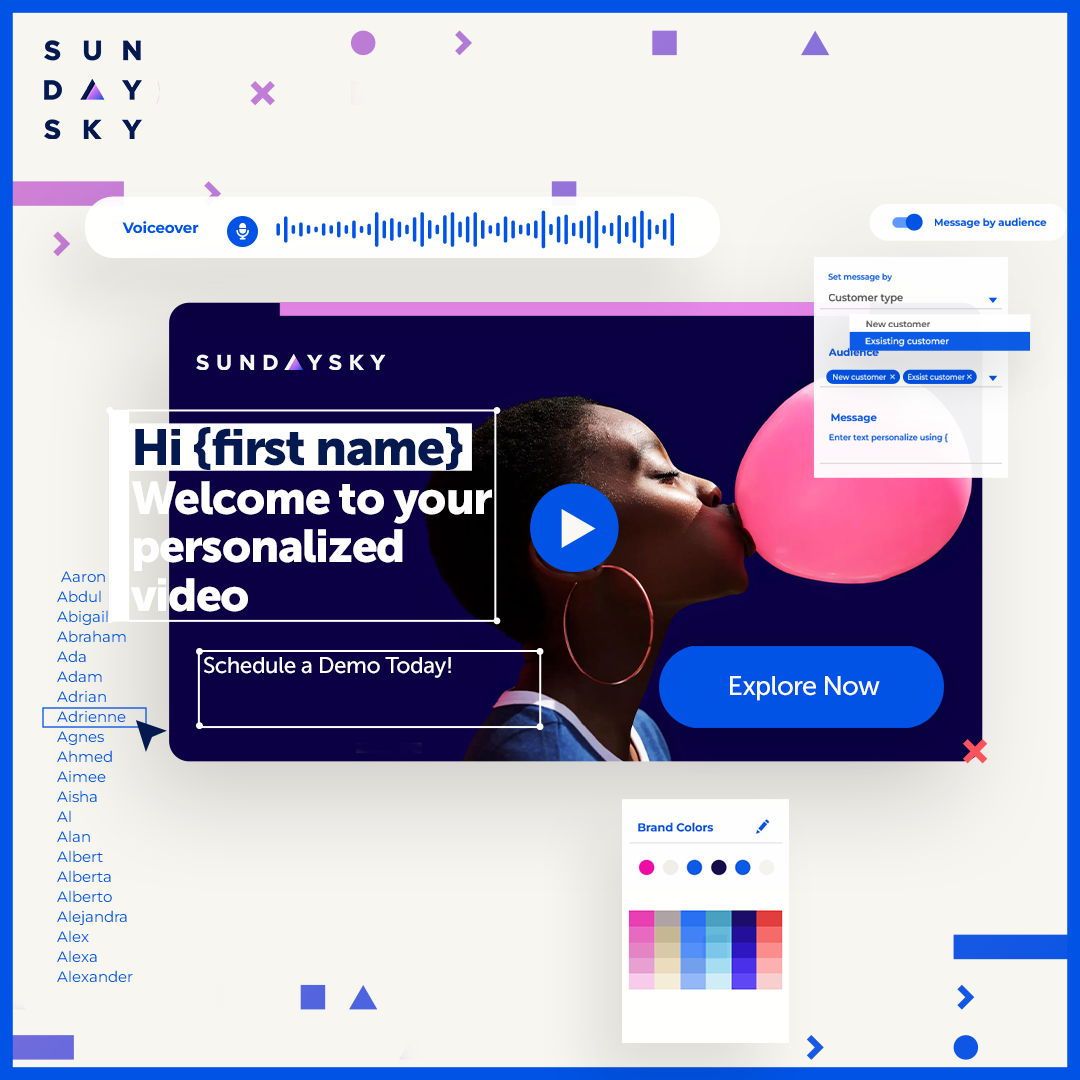
This balance of flexibility and governance is absolutely essential for implementing a positive personalization experience at enterprise scale. For example, SundaySky’s personalized video platform enables CX teams to create modular video experiences that dynamically adapt to each viewer, all while maintaining centralized control over brand, messaging, and compliance. By connecting customer data to video templates, teams can deliver clarity and relevance without slowing down production or review cycles.
Real-world hyper-personalization in action
Across industries, CX leaders are using personalized video to activate hyper-personalization strategies:
- Financial services teams use personalized videos to explain statements, fees, or loan changes, helping reduce call volumes and increase digital engagement
- Insurance and healthcare organizations deliver tailored onboarding and claims guidance that builds trust during high-stress moments
- SaaS companies personalize onboarding, feature adoption, and renewal messaging based on actual usage rather than assumptions
These use cases succeed because video connects data → story → outcome in a way other formats struggle to match. You can explore additional examples in SundaySky’s customer experience solutions and customer stories.
Getting started with hyper-personalized CX (without overcomplicating it)
Hyper-personalization doesn’t require a massive overhaul. The most successful CX teams start small and scale intentionally.
A practical starting point:
- Identify one high-impact lifecycle moment (e.g., onboarding or renewal)
- Define the key customer questions at that moment
- Use data you already have to personalize relevance
- Deliver the experience in a format customers will engage with—like video
- Measure impact on engagement, comprehension, and support deflection
From there, expansion becomes much easier.
The future of customer experience is personal and visual
Hyper-personalization is no longer about proving what’s possible. It’s about delivering what customers expect: experiences that feel relevant, timely, and easy to understand.
Video helps you activate a robust personalization strategy by turning customer data into clear, human communication. With video, CX teams can finally close the gap between insight and impact.
That’s how hyper-personalization moves from concept to competitive advantage.
Download our complete guide on video personalization today
Interested in using SundaySky to activate your personalization strategy? Book a demo today